

Key points
- On a SUP you stand the whole time and move with one long paddle; in surfing you lie down to paddle, then stand up to ride a wave.
- SUP works on calm, flat water as well as along the coast, so it does not depend on waves.
- In surfing most of the time goes into paddling and waiting, and the rides are short and fast.
- SUP suits a relaxed session at your own pace; surfing suits people who want the rush of a wave and don't mind falling in.
- For surfing, a lesson is the usual way to start.
In this article
Stand up paddle and surfing look like close cousins. Both happen on a board, both happen on the sea, and both end with you standing up. Spend an hour doing each, though, and you quickly notice how different they feel. One is a calm, steady glide at your own pace; the other is a series of short bursts of speed, with plenty of paddling and waiting in between.
If you are trying to decide which one to book, here is how they compare: how each one works, how it feels, how hard it is to learn and who it tends to suit.
How stand up paddle works
On a stand up paddle board (SUP) you stand on a large, wide board and move yourself with one long paddle. The board is much bigger and more stable than a surfboard, which is what makes standing on flat water possible from the very first session.
You choose the direction and the pace, so SUP works on calm, flat water as well as along the coast. You can glide slowly and look down into the water, or paddle further and turn it into a proper workout.
The basic SUP technique
- Start on your knees in the middle of the board, then stand up one foot at a time, feet about hip-width apart.
- Keep your knees soft and your eyes on the horizon, not on your feet.
- Hold the paddle with one hand on top of the handle and the other lower down the shaft.
- Reach forward, put the whole blade in the water and pull it back towards your feet. Switch sides every few strokes to keep a straight line.
A classic beginner mistake is holding the paddle the wrong way round. The blade is angled, and that angle should point forward, away from you, so each stroke pulls you cleanly through the water.
How surfing works
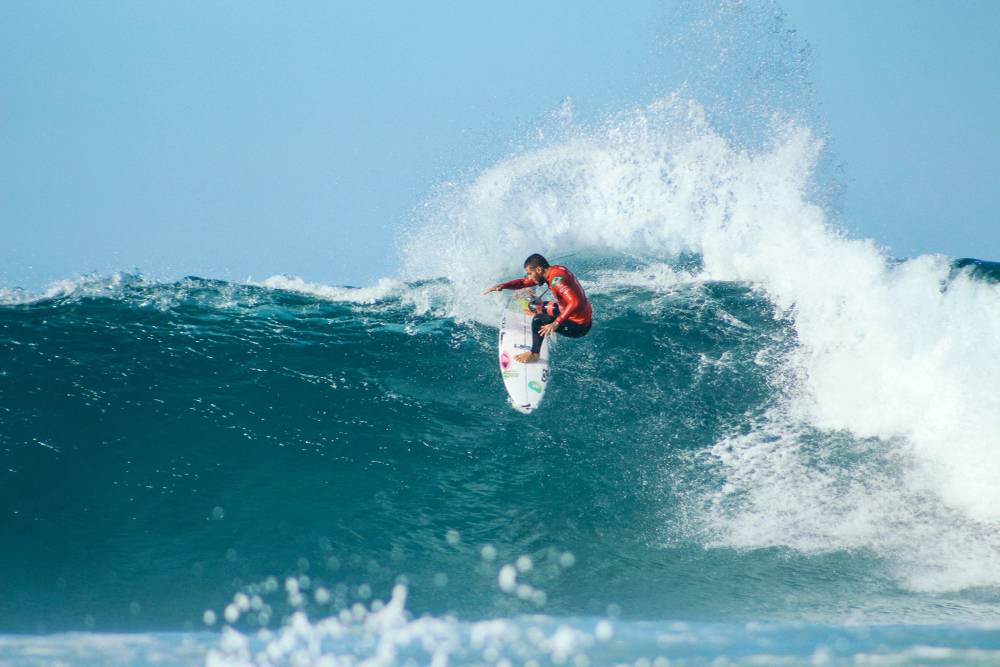
A surfboard is smaller. You lie on it to paddle with your arms, then pop up to your feet as a wave pushes you forward. The wave does the work of moving you; your job is to catch it, stand up at the right moment and stay balanced.
Most of the time in surfing goes into paddling and waiting: paddling out, waiting for the right wave and paddling hard to catch it. The ride itself is short and fast, often just a few seconds for beginners, but those few seconds are what keep people coming back.
Beginners start in the white water, the broken waves close to the beach, where everything is slower and more forgiving. Our article on the basic moves of a first surf lesson goes through paddling, the pop-up and riding the white water in more detail.
How they feel on the water
The biggest difference is rhythm. SUP is continuous: you are standing, paddling and moving from start to finish, and you set the pace. It feels calm and open, with plenty of time to look around, chat with friends or watch the water below the board.
Surfing comes in bursts. There are quiet moments lying or sitting on the board, then a few seconds of hard paddling, then the rush of a wave carrying you towards the beach. It is less predictable, because the sea decides when the next wave arrives.
Learning curve and falling in
Many people manage to stand up on a SUP in calm water during their first session. The first few minutes feel wobbly, then the board starts to feel steady and you can focus on paddling. You may still fall in, but it is usually a slow topple into calm water, followed by a laugh and a climb back on.
Surfing takes longer. Standing up on a moving board while a wave pushes you is a skill that needs repetition, and almost everyone falls many times in their first session. That is completely normal, and it is exactly why a lesson is the usual way to start: an instructor helps with timing, technique and choosing the right waves.
On a SUP, the first win is standing up. In surfing, the first win is standing up on a moving wave, and that takes a few more tries.
What each one asks of your body
- SUP works your legs and core for balance, and your shoulders, back and arms for paddling. You can keep the effort gentle or turn it up.
- Surfing is heavy on the arms and shoulders from paddling, with short bursts of effort for the pop-up. Expect tired arms after your first session.
- Both are easier when you feel comfortable in the water, and both mean plenty of time in the sun, so sun protection matters.
Choose SUP if…
- You want a relaxed session with time to look around.
- You would rather your plans did not depend on waves.
- You are with a group of mixed ages or confidence levels and want everyone on the water quickly.
- You like setting your own pace, from a slow glide to a longer, harder paddle.
Choose surfing if…
- You want the rush of riding a wave towards the beach.
- You are happy to fall in, laugh and try again.
- You enjoy learning a skill that gets better with every session.
- You don't mind spending time paddling and waiting for the right wave.
For surfing, a lesson is the usual way to start. When you book, tell us how much surfing each person has done before, so the lesson can start at the right point.
Why not try both?
SUP and surfing are not an either-or choice. Some people start with a calm SUP session to get used to standing on a board, then book a surf lesson for the waves. Others do it the other way round. Both build balance and confidence on the water.
Ask about SUP in Sanur or surf school lessons on WhatsApp. Send your date and group size, and mention both in the same message if you want to ask about more than one.